SPOTLIGHT IS A SOCIAL PLATFORM WHERE ARTISTS SHARE THEIR CREATIVE PROCESS — NOT JUST POLISHED OUTPUTS — AND CONNECT WITH A COMMUNITY BUILT AROUND CRAFT, NOT REACH.
Designed an artist-first social platform; launched live web product, established complete brand system, owned the Badge Submission flow end-to-end (design → code → ship).
Product Design Lead
Spotlight Creators (Startup)
Aug 2024 – Present
Figma · Figma Make · Vercel
Designed for the artist, not the algorithm
For artists, social media is essential — and exhausting. Mainstream platforms reward polish and reach, pushing artists toward algorithm-friendly posts and follower counts rather than the messy, real creative process behind their work.
Spotlight exists to give artists their space back. It's a social platform built specifically for artists to share their process, build authentic profiles, and engage with a community that supports their craft rather than ranking it.
As Product Design Lead in a cross-functional team spanning design, engineering, and business, here's what I owned:
Brand Identity System
Established Spotlight's complete visual language — logo system, color palette, typography, and full brand guidelines. Owned the identity from concept through documented system.
UI Design Across Web & Mobile
Led product UI design across both platforms — translating the founder-set direction into coherent, shipped interfaces the engineering team built from.
Badge Submission, Design to Ship
Owned the Badge Submission feature end-to-end and took it further: built the flow as a deployable web app — a self-initiated step to pressure-test the design through real code.
Day-to-day, I also led design reviews and mutual feedback with the other designers. Research, information architecture, and broader product strategy were founder-led.
What's broken for artists today
Artists struggle to find a platform that supports their craft on their own terms. Existing networks reward polish and reach, but offer little space for the creative process, rich artistic identity, or genuine collaboration between artists.
Design a platform where artists can share their creative journey, build rich personal profiles, and connect with others for collaboration — in a community built around their craft, not their reach?
Grounding the product in real artist needs
Our team ran a mixed-methods study to ground the product in real artist needs — qualitative depth from interviews, quantitative validation from a survey, and competitive context from the platforms artists already use.
User Interviews
Conducted with artists across different career stages — from newly graduated students to established professionals — to understand authentic versus performative sharing behaviors.
Survey
Validated qualitative findings at scale to confirm patterns around process-sharing, profile depth, and the kinds of artist-to-artist connection people actually wanted.
Competitive Analysis
Analyzed three platforms artists already lean on — Instagram, ArtStation, and Patreon — to map where each falls short for artist-specific needs.
Three patterns shaped the product
Desire to Share the Creative Process
Artists want to showcase the journey behind the work — sketches, iterations, behind-the-scenes — not just the final output. Sharing process builds deeper connection with their audience.
Unclear Artist Profiles
Existing platforms give artists shallow profiles. They want detailed identity: education, art style, mediums, influences — context that lets viewers understand them as artists, not just feed entries.
Lack of Networking Opportunities
Artists want structured ways to find collaborators, mentors, and peers — not just followers and likes.
Who we designed for
Three personas anchored design decisions across the product — covering the breadth of who shows up on Spotlight.
Newly Graduated Students
Aspiring artists fresh out of academic training, eager to build their portfolios, gain industry exposure, and connect with professionals to kickstart their careers.
Professional Artists
Established creatives seeking a platform to showcase their work, network with industry peers, and access opportunities for collaboration, growth, and inspiration.
Recreational Artists
Hobbyists passionate about art who seek a community to share their creations, explore new techniques, and be inspired by others — without the pressure of professional demands.
Rough sketches, real decisions
Low-fidelity sketches and interactive wireframes mapped the core flows before any visual design — focusing on the Artist Profile and Artist Journey features, where the product's authenticity-over-polish thesis lives or dies.
A brand that feels like the product
The brand had to feel warm and creative — a counterweight to the corporate flatness of mainstream platforms — while staying confident enough to feel like a real product. Deep blue grounds it; warm orange and yellow signal energy and creative spark. The tagline came directly from the product thesis: Inspiring artists to unlock their true potential.
Logo System
The Spotlight wordmark uses a custom-set Montserrat treatment where the 'O' is replaced by the Spotlight logomark — a stylized spotlight beam in warm orange against deep blue. Four variations cover light, dark, branded, and monochrome contexts.
Logomark
A standalone circular mark for app icons, social avatars, and any space too tight for the full wordmark. The spotlight beam reads at any size.
Logo Usage Guide
Both wordmark and logomark require a minimum 15px clear space on all sides to maintain visual integrity. The clear space scales proportionally as the logo scales.
Color Palette
Deep blue grounds the brand. Warm orange carries the spotlight metaphor — the moment a beam picks out a creator from the crowd. Yellow and cream warm and lighten the system across UI surfaces.
Typography
Montserrat across the entire system, in Light, Regular, Bold, and Black weights. Geometric, modern, and broadly available — readable at every size from app UI labels to brand marketing.
The product, by feature
The product splits across web (live) and mobile (in active development). The designs below show the production-ready specs across the core features — including two flows I led: Badge Submission and Badge Collection Page.
Artist Profile
Detailed identity cards that go beyond bio + follower count. Education, mediums, influences, and a dedicated space for process work.
Artist Journey
A timeline view of an artist's creative process for any given piece — sketches, iterations, finished work — letting other artists follow the *how*, not just the *what*.
Events Update
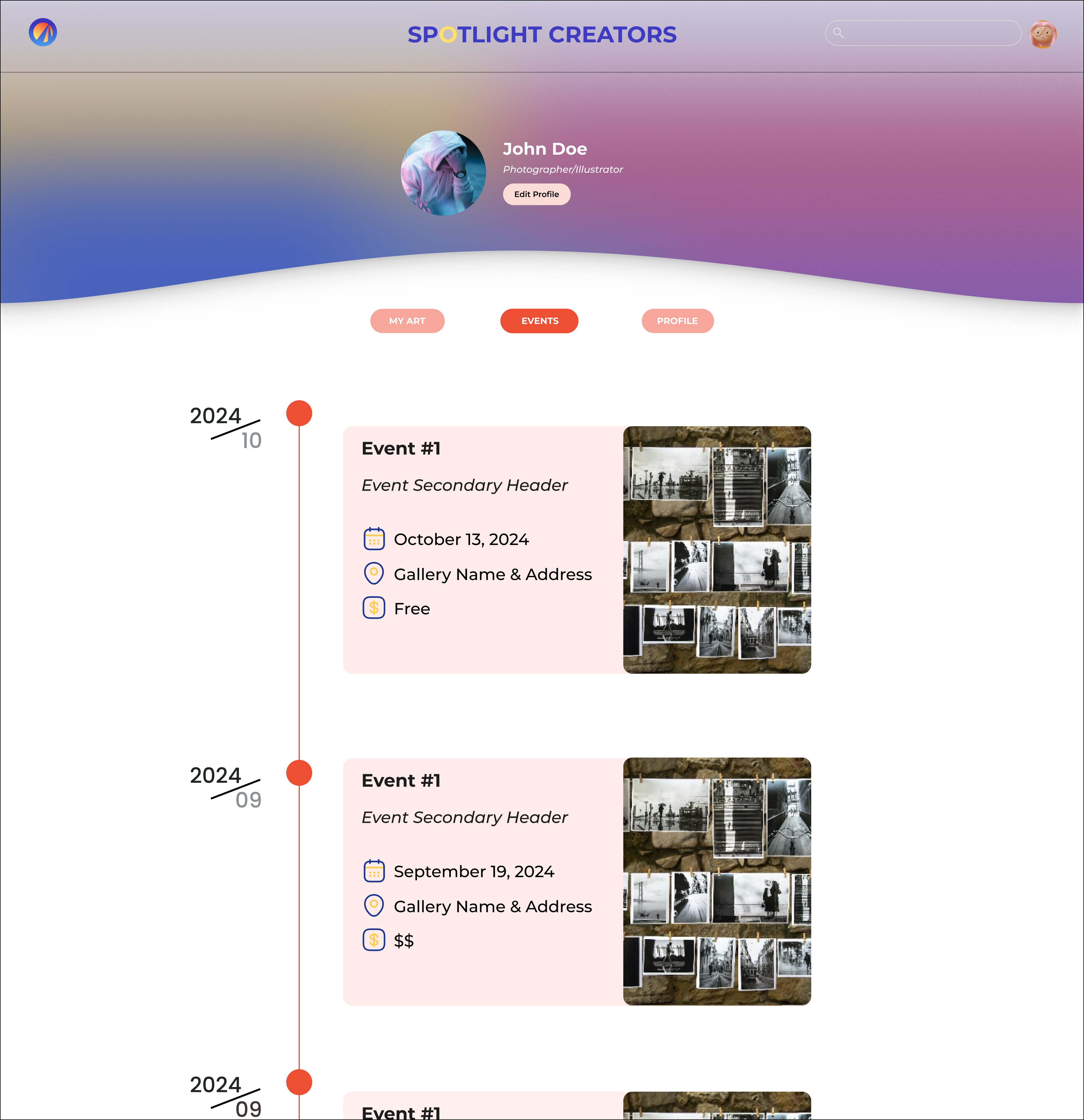
A feed dedicated to artist shows, exhibitions, and live events — so following an artist means actually keeping up with their real-world work, not just their algorithm posts.
Badge Submission
Spotlight rewards artists with community-recognition badges for participation, craft, and growth. I designed the full submission flow — entry, file upload, criteria review, status tracking — in collaboration with Angel and the team. I then built this flow end-to-end as a deployable web app (see Vibe Coding section below).
Badge Collection Page
A dedicated space where artists grow a personal badge collection — earn badges for joining Spotlight, completing daily and weekly tasks, or as special holidays roll around. Artists can also purchase badges designed by fellow creators, turning everyday platform engagement into a collectible motivation loop.
Flows Behind the Features
Five task-oriented scenarios pairing each flow with its shipped UI — structure and interaction side by side.
01 · New User — from landing to first feed
First-time artist onboarding: sign up, verify, set profile basics, pick mediums and style, get follow suggestions, land in the feed.
02 · Return User — logging back in
Returning artists log in and land straight into the feed. Explore surfaces discover, events, and notifications from a familiar starting point.
03 · Artist — Upload Artwork
Sharing a finished piece or a work-in-progress. Artists choose type, upload media, add context (title, caption, tags), preview, and publish.
04 · Artist — Add Events
Artists post upcoming shows, exhibitions, and workshops from their profile — filling event details, previewing, and publishing to their followers.
05 · Artist — Edit Profile
Updating identity, bio, mediums, style, and education from the profile view.
The mobile experience, in your hands
The mobile experience is in active development. The interactive prototype below maps the production-ready specs for the core flows.
(URL to be added)
See it in production
Spotlight's web platform is live. Try the launched product yourself.
From design to code: Badge Submission
Beyond designs handed off to engineering, I wanted to close the loop on at least one piece of the product. The Badge Submission flow became that piece.
I designed the flow in Figma alongside the team, then built it end-to-end using Figma Make and deployed to Vercel. Shipping it myself meant catching the gap between what looks easy on a Figma frame and what actually behaves correctly in a browser — state, validation, edge cases that don't show up until something is live.
Why I did this
Designers learn faster about their own decisions when they have to make them survive contact with real code. This was less about replacing engineering and more about closing my own feedback loop — and giving the team a live reference they could pull from for the production build.
Where the product stands
The web platform is live at thespotlightcreators.com. The mobile app is in active development — the designs shown represent the current production-ready spec. The Badge Submission flow is being deployed as a standalone Vercel app and will be linked in the Vibe Coding section above once live.
What I'm taking from this
Leading product design at a startup means owning every layer — research, brand, UX, UI, and increasingly the build itself. The clearest thing I took from Spotlight: knowing when to hold the line on a design decision and when to let engineering or business constraints reshape it.
Cross-functional fluency — translating between the founders, engineers, and the artists we were designing for — turned out to be the bigger half of the job. Shipping the Badge Submission flow myself sharpened that further: it forced me to make decisions a designer can defer in Figma but can't defer in a browser.
Where Spotlight is heading
Four directions the team is exploring for v2 — each pulled from research signals we couldn't ship in the first release, and each designed to deepen how artists engage with the platform.
Map-Based Artist Locator
Discover artists nearby for collaborations, workshops, and local art events — making the network feel like a real community, not just a feed.
Badge Submission — Official Launch
Open badge submission to the community: artists submit their own badge designs, and selected badges get featured in the official Badge Shop for others to purchase. Selected artists earn rewards for their contributions.
Marketplace & Official Badge Shop
Direct artist-to-buyer sales for original work, prints, and commissions — launched alongside the official Badge Shop, giving artists two new revenue channels without ever leaving the platform.
Badge Page
A dedicated collection space where artists earn badges for completing tasks or hitting membership milestones — turning platform engagement into visible recognition, and giving artists another reason to keep showing up.